
It all started on a stay-at-home Coronavirus afternoon when Gingerbread decided to jump off the couch.
The 7-pound, Bichon/Poodle landed awkwardly on her front right paw. She let out a yelp; held the paw up in the air and then started crying.

It was another crisis in these homebound times. I called the Country Oaks Veterinary Clinic in Summerfield, where Gingerbread has been treated since her birth seven years ago.
The clinic was short-staffed and busy due to COVID-19 restrictions. But a receptionist told me to go its webpage and set up a telemedicine exam with Dr. Frances Ramirez DVM, head of the clinic.
Every day seems to bring a different adventure in our brave, new Coronavirus world. Gingerbread and I were about to embark on our first computer-generated visit with a vet.
We were not alone.
Ramirez has been treating animals for years, but about a month ago had to make radical changes for her staff of 24, and herself.
One of those changes was treating patients by computer, in the increasingly common practice of telemedicine.
“It was something we were thinking about, but we figured we would have months to prepare,” Ramirez said. But, due to the virus restraints, “we had one week,” she added.
Technology is never as easy as it looks. Telemedicine means interacting by camera with pets and their owners. It also means credit-card billing by computer, and not only requires computer-savvy by the doctor, but also the pet owners who have to call in.
The stronger the Wi-Fi signal, the better.
I found it fairly simple to logon, but that was just the start. I had to hold the computer in my hands and try to keep the camera on the dog, who was feeling better but still jumpy.
“I’d like to see her walk,” Ramirez said.

So, I put Gingerbread on the rug, and she was pumping adrenaline after seeing Ramirez on the computer screen. Gingerbread started to scamper around the living room for about 10 seconds as I chased her with my portable computer camera.
Finally, she slowed down, and then walked with a slight limp.
“She is moving good, but I can see it hurts her,” Ramirez said. “I don’t think it’s anything serious; probably a sprain.”
The doctor prescribed some pain medication, which I already had in the house. She also said if the leg worsened, or the dog was in pain the next day, to set up an appointment and bring her in the clinic.
“But I think she will be fine,” Ramirez said.
Gingerbread was back to normal in three days.
Telemedicine was a learning experience for me, as it has been for Ramirez and many others in the medical community during this crisis.
“This is not ideal because of the restrictions; obviously I would rather see the animal in person,” Ramirez said. “I would like to take her temperature, feel the leg and see how the dog reacts.
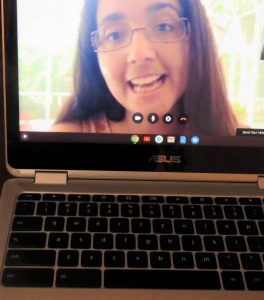
“But telemedicine is a way to handle an emergency right now. It’s a good way to triage – to categorize an emergency. You can find out if it’s something serious and needs immediate care. When I saw Gingerbread walk, I knew it was just a sprain.”
Ramirez said she can only treat existing patients by telemedicine, not new ones.
“It helps that I know their medical history,” she said.
Doctors aren’t the only ones making the adjustment; so are pet owners. Some owners are not as computer literate as others.
“I’d say it’s 50-50,” Ramirez said. “About 50 percent of the pet owners feel comfortable with the technology. Many older clients are not as comfortable. I try to explain, but if they can’t do it, I call them on the phone.”
Ramirez offers the following advice for pet owners forced to stay home during the Coronavirus crisis: “Try to keep the pet’s normal routine as much as you can. Go out for a walk if you can; and keep the regular diet.”
Ramirez possesses a warm and comforting manner for pets and their owners.
“I miss being at the clinic and with the people and their pets,” she said. “I always feel better when I see them and I miss that interaction so much.”
The same holds true for the staff.

“We have Zoom conferences with the management team,” Ramirez said. “It makes me feel better, because I get to see their faces.”
Virus or not, unexpected emergencies still happen.
Last week, someone abandoned a 2-year old Pitbull mix and tied it to a pole near the clinic.
“We called him Blue and he’s getting better,” she said, noting that the clinic has two other abandoned dogs for adoption. Those interested can call the clinic at (352) 347-7387.