
Community Development District supervisors heard presentations Friday about accidents on and design of the multi-modal paths as the striping debate continues in The Villages.
Members of the Project Wide Advisory Committee who had heard this presentation earlier this month, had asked that CDD supervisors be given the opportunity to hear the same information.
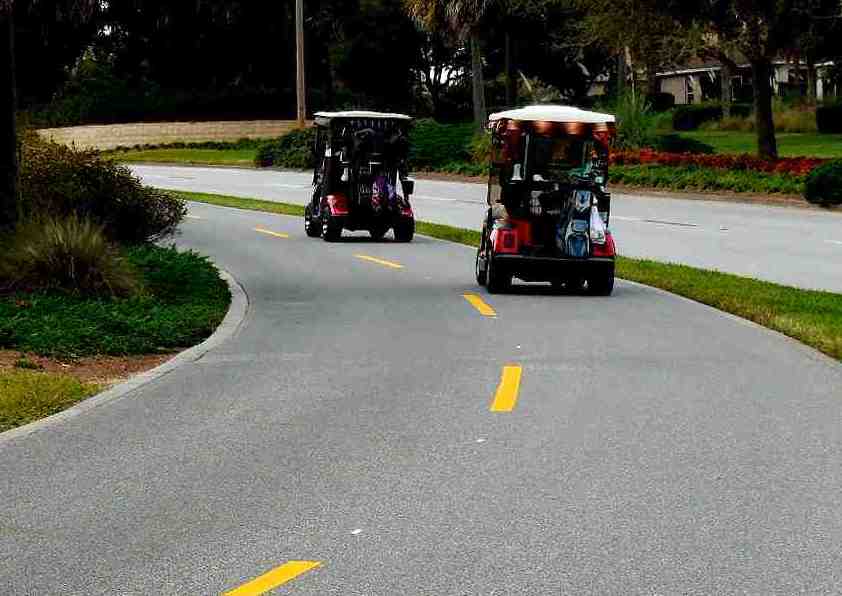
Lt. John Longacre of the Villages Public Safety Department said there have been 65 accidents on the golf carts paths in The Villages in the past five years. Forty-four of those accidents included injuries.
Most of the accidents happened between 9 a.m. and 6 p.m.
The majority of the calls are for golf carts running off the paths, Longacre said.
Richard Busche of Kimley-Horn & Associates engineering firm said he has been involved in the design and construction of multi-modal paths in The Villages for more than a decade.
He oversaw the reconstruction of paths in the older section of The Villages. Paths have evolved from 10-foot, concrete paths to 15.5 -feet asphalt paths. With the ribbon curbing that makes the path a total of 16 and a half feet across, Busche said.
The 30 miles of multi-modal paths is designed to accommodate multiple forms of traffic, including golf carts, runners and walkers, bicyclists, rollerbladers and others, he said.
He said the stripe wasn’t omitted on the trail, but was deliberately left off.
“Putting a stripe down the center line would fundamentally change the trail,” Busche said.
The center line would change it from a multi-modal path to a “golf cart highway,” he said.
He said public opinion is well intended, but the data doesn’t support striping.
And he said, consistency throughout The Villages is necessary.
“This items cannot be addressed district to district,” Busch said. “If you are going to add a center line stripe, you need to do it from top to bottom. We wouldn’t stripe Buena Vista Boulevard differently in District 7 than in District 3.”
However, he said Kimley-Horn’s recommendation is to not stripe.
“There is no data to warrant a change,” Busch said.
He said he has traveled the multi-modal paths in a golf cart.
While he was obeying the speed limit in the golf cart, he said that many carts were passing his at high rates of speed.
“People are really booking out there,” Busch said.
CDD 6 Supervisor Joyce Edmonds said speeding, aging and driving in the rain could all be contributing factors to accidents.
“We seem to be forgetting that we are responsible for our own behavior,” Edmonds said.
Fellow CDD 6 Supervisor John Calandro agreed that people need to be responsible.
He said that drinking, inattentiveness and sleepiness are also contributing factors in some golf cart accidents.
“Behavior is the thing we need to modify,” Calandro said.
CDD 7 Supervisor Jerry Vicenti said he surveyed residents of his district and the vast majority indicated that they are in favor of striping. He said as an elected official, he has a responsibility to represent their viewpoint.
“My purpose as an elected official is to listen to the people,” Vicenti said.
In CDD 8, Supervisor Victor Ray said golf carts can be “lethal weapons.”
He said he has spent some time driving the striped golf cart path in CDD 4.
“The stripe makes a big difference,” he said.
However, CDD 8 Supervisor Dennis Hayes warned his fellow supervisors it would be dangerous to disregard the professional opinion of the engineer and go ahead and stripe as was done in CDD 4.
“If we have a golf cart hit and kill a pedestrian, the liability will fall on the residents of District 8,” Hayes said.
Here’s a look at what the supervisors decided:
• CDD 5. Chairman Walter Martin indicated that while a vote had not been taken on striping, a consensus had previously been raised not to stripe.
• CDD 6. Chairman Sally Moss said the board reached a consensus that Supervisor Peter Moeller would continue to research the issue through PWAC. No vote was taken.
• CDD 7. Supervisors decided to ask PWAC to undertake a study on side striping.
• CDD 8. Took no action.