
Around and around the Jerry Lewis’ life story goes, where it stops nobody knows: Dean Martin, nightclubs, movies, Buddy Love, Jerry Langford, MDA Telethons and, on Friday, The Villages.
Jerry Lewis — showbiz legend, cantankerous comic, innovative movie director, ego-driven performer, dedicated humanitarian, beloved by many and criticized by some – is two months shy of his 90th birthday.

He will be on stage Friday at 7 p.m. in the Sharon L. Morse Performing Arts Center.
“Some people ask me: ‘Why bring Jerry Lewis to The Villages?’ said Joe Bamford of Get Off The Bus promotions, which booked Lewis here.
“I say why not bring Jerry Lewis to The Villages,” Bamford added. “Jerry Lewis is a legend. How many people who live in The Villages can say they saw Jerry Lewis in person? I think people want the chance to see him live.”
You might call Lewis’ current gig a performance, but it’s really Jerry Lewis being Jerry Lewis. It includes film clips of his movies, friends and family along with his performances dating back to the late 1940s. He also answers questions from the audience. As usual, Lewis can be naughty and nice talking to an audience.
Few, if any performers in the history of show business can match Lewis’ body of work or his longevity.
Lewis started on stage as a child but his career took off in 1946 – 70 years ago – when the loud-mouthed kid teamed with a handsome, older singer named Dean Martin.
Lewis once described the act this way: “Don Juan (Martin) and the monkey (Lewis). The playboy and the putz.”
They became the hottest team in the entertainment world, kind of a cross between the Beatles and Elvis during the early ‘50s. After dominating the nightclub circuit, Martin and Lewis moved to movies and television with spectacular success.
Starting with “My Friend Irma” in 1949 to “Hollywood or Bust” in 1956, Martin and Lewis were box office boffo, as they say in Variety.

But Dean got sick of playing the straight man while everyone loved Lewis, who called himself, “the monkey.”
The world was shocked when the two split in 1956, but they had no other choice. The divorce was bitter.
“We were finally divided by outside factions,” Lewis once told NBC-TV. “Someone said to Dean, ‘You don’t need him. Why don’t you just sing and do films yourself.’ And I was getting poisoned as well. ‘What do you need him for?’ … I hated him for allowing the split to happen. He hated me for allowing the split to happen.”
The two would not appear together again until 1976, when Frank Sinatra brought Martin on stage during the Muscular Dystrophy Telethon hosted by Lewis.
“When he walked toward me all I thought was ‘Dear God, give me something to say,’ Lewis told NBC. “So I looked at him and asked ‘Are you working’? That got a laugh. It relaxed him, it relaxed me. And we never talked after that for another 10 or 15 years.”
But, after the death of Dean Martin’s son in the late 1980s, Lewis attended the funeral. The two became close until Dean Martin’s death on Christmas Day in 1995.
After Martin and Lewis split up in 1956, Jerry went on to a successful solo film career. Two of his outstanding comedies that he directed are: “The Bellboy,” 1960 and “The Nutty Professor” in 1963. Both are considered classics.
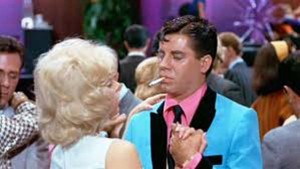
The “Professor” was remade by Eddie Murphy in 1996. Lewis created two characters in the film: the meek and shy professor Julius Kelp and the hip and wild womanizer known as Buddy Love.
Despite making millions of dollars in dozens of films, Lewis never quite got the appreciation in America some feel he deserved.
“In a way, Jerry’s movies never were embraced here, at least not in the way they’ve been in France,” famed Director Martin Scorsese told GQ, adding Lewis offers a combination of mastery and vulgarity. “Jerry Lewis is still ahead of his time.”
Scorsese directed Lewis in a memorable dramatic role in “The King of Comedy,” in 1982. He plays Jerry Langford, a talk-show host kidnapped by Robert Di Niro. Lewis turns in a remarkable, piercing and angry performance.
Despite such talent, Lewis’ antics bug a lot of people and he has a tendency, even with his fans, to say outrageous, insulting things.
“He makes many people uncomfortable,” Scorsese told GQ. “He doesn’t censor himself as a performer, a filmmaker, or a public figure—which is difficult to accept for many people….I think Americans are still coming to terms with Jerry and his astonishing artistry. It’s as if they had to invent a new place for it, a new category.”
“If you don’t get Jerry Lewis, you don’t really understand comedy, because he is the essence of it,” Jerry Seinfeld said in the documentary, “Method to the Madness of Jerry Lewis.”
In addition to his film career, Lewis was best known for hosting the MDA Telethons. He hosted the program for 61 years, raising over what he said was $2.6 billion, but he was dropped after 2011.
“They do what they have to do and I respect that,” Lewis told Fox News. “After 61 years we raised 2.6 billion dollars. I feel pretty satisfied about the 61 years of constant looking to make children better.”
Now, in the twilight of his life, Jerry Lewis is back on the theater circuit talking about all his experiences. He still packs a punch. And he doesn’t care much for a public obituary while he’s still breathing.
“People say, ‘How would you like to be remembered?’” he told NBC. “I don’t want to be remembered. Gimme a break. What I want is to hear what’s great about me now. Let me hear it! In the box you don’t hear these eulogies.”