

The smell of fresh-cut wood permeates The Villages Woodworking Shop on Rolling Acres Road.
Power tools make interesting noises and people move back and forth. Many of the members are busy on their own projects, as well as producing toys and other items for charities.
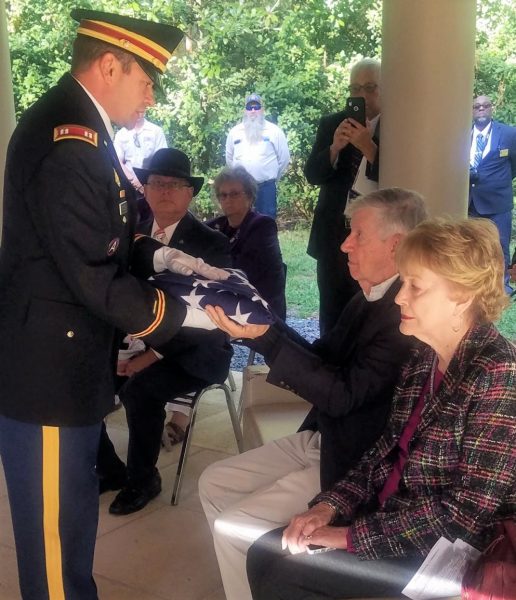
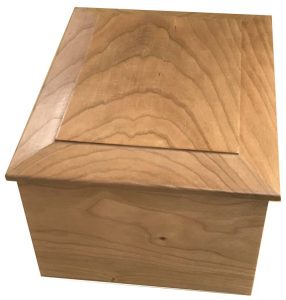
One group handcrafts wooden funeral urns, or boxes, for the families of veterans who can’t afford a suitable container for the cremated remains of their loved ones. The boxes are donated to the various national cemeteries in Florida, including the Florida National Cemetery in Bushnell. The Project supplies crests of the various military branches that are applied to the box by cemetery staff.
Alvin Corenblum, one of the Urn Project organizers, points out that the boxes are not for retail sale.
“We make them strictly for the families of veterans and we donate them to the Florida national cemeteries,” he says. “The cemeteries allocate them after the families complete the qualifying paperwork.”
The group started about four years ago after seeing a need for the urns.
Bill Beck, a Village of Gilchrist resident, said it takes at least five man-hours to complete a box.
“We usually do 25 to 30 at a time when we get the wood,” he said, adding that most of the wood is donated or purchased with donated funds.
“We use a standard design, although it has been altered over the years,” says Scott Herlick. “We used to make a taller box, but it’s been lowered to fit into a standard USPS shipping carton.”
The Village of Santo Domingo resident says the box weighs about seven pounds. The bottom slides out to allow the cremated remains, in a plastic box, to be inserted. While individual urns may be mailed to the cemetery, the group prefers to deliver several to a cemetery at once and let the cemetery distribute them as needed.
The latest run was made from cherry wood, but they have used maple, cypress and cedar, among others.
“The cost of the wood for a run of 25 boxes usually runs around $200,” says David Beck, of the Village of Santiago.
Funds are deposited into The Villages Woodshop account, where the Urn Project is a line item – and accessed when needed.
“At the end of the year, any deficit in that account is often taken care of by the Shop,” Beck says.
While all of the Urn Project people at the shop are experienced woodworkers, Corenblum has been making sawdust his whole life. Born in Savannah, Ga., in 1923, Alvin’s family was in the lumber and woodworking business.
“My father was an excellent teacher,” he says. “If he saw a wood product that could make money, that’s what we’d be making,” he laughed.
Alvin started at West Alabama Polytechnic Institute (which was renamed Auburn University in 1960) in 1941.
“You had to be in the Army and in ROTC to attend,” he says. “And in 1942, they decided that we would be better off on active duty.”
After a series of posts in the United States, Alvin developed an acute ear infection that put him in hospital for several months. That ended his military career.
Back on civvy street and newly married, he rejoined the family business, which had relocated from Alabama to Miami. They mass-produced all types of millwork, furniture and constructed homes. Then, in his mid-1930s, Alvin stated his own business importing industrial woodworking equipment.
“We decided it would be best if I went on my own because the rest of the family wanted to stay in woodworking and building,” he says.
For the next 40 years, Alvin bought and sold industrial woodworking equipment from many international sources and sold it all over the world. “Our furthest customer was in Australia; our nearest was the big woodshop next door in Miami,” he says.
After 32 years of marriage, Alvin’s first wife passed away and he eventually remarried.
“After I retired, we looked at The Villages, but my wife said she wasn’t leaving the shops and so on in Miami,” he smiled. “But after she passed away, there I was in Miami all by myself. My son in Winter Park suggested I should look at The Villages again.”
He visited The Villages Woodworking Shop.
“I said, ‘That’s it!’ Went back to Miami. Sold my house and moved here,” says Alvin, who lives in the Village of St. Charles. “Best move I ever made.”
The shop has become Alvin’s headquarters. He’s there most days and shares lunch with several friends. He often helps other shop members with their projects. One of his own ongoing projects is making little wooden trucks.

“They’re made up of a number of pieces and hold a couple of bottles of wine,” he says. “So, about this time of the year I start cutting out the pieces and put them together in time for the holidays.”
Most of the trucks go to charities to be auctioned off.
“The woodworking club, the Greek-American Club and others use them as fundraisers,” he says.
When Alvin enters the shop’s lobby, he is greeted by handshakes, hugs and good-natured teasing.
“I just enjoy being here. Working here. That’s good,” he says with a wide smile of satisfaction.
John W Prince is a writer and Villager. For more information visit www.GoMyStory.com. If you know of someone with a good story, contact John at [email protected].