
Pine Ridge Villager John Nolander has vivid memories of getting his flying license using the Jeppesen Private Pilot Course, a publication of Jeppesen & Co. of Denver, Colo.
“By the time I was 16 I had my student license and could fly solo,” Nolander says. “The next step to private license is to get more instruction, more flying hours, and take written exams.”
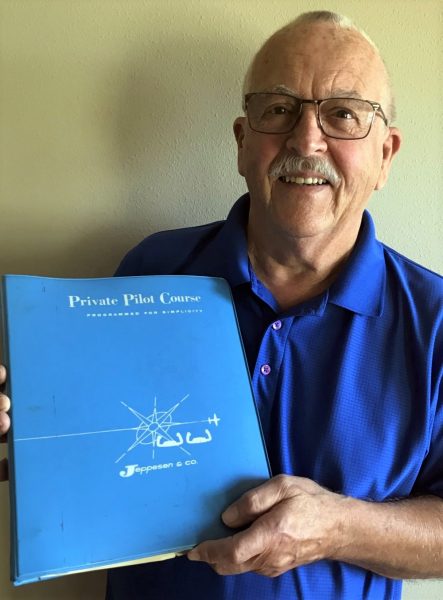
Interrupted by life – college, marriage, children – he resumed flying toward his goal in 1965, studying the Jeppesen Manual. He went on to also get his hot air balloon and glider rating.
Moving to Anchorage, Alaska, John joined the Seven Star Flying Club, a group of private pilots that flew Cessna 180s and Piper Super Cubs into the Alaska bush for hunting, fishing and exploration expeditions.
In the introduction to the manual, Capt. E.B. Jeppesen noted that “Most ground school text material simply has not kept pace with aviation development and pilot requirements.” He added that “Our company’s slogan is now, and always will be, ‘service for safety.’”
Back in the 1920s and ’30s, when aviation pioneer and barnstormer Elrey Borge Jeppesen started to fly, there were few rules or standards. “Don’t take off unless you’re sure the airplane will fly” was one of the basics.
Years later Elrey’s son Richard wrote in the introduction to his father’s biography, “There were no universities of flight then. There were no aircraft construction standards. No regulations, no rules, and no airports either. Nobody knew how much turbulence an airplane could withstand and stay together. Nobody knew whether a plane could do a loop or a spin without the wings coming off. It was trial and error and to error was to die. These pioneers risked their lives so that those that followed could learn from their mistakes. It was a deadly business.”
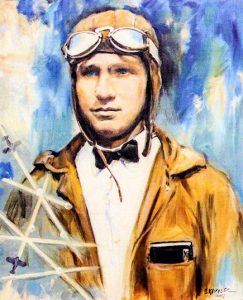
Vitally interested in flight safety and aviation standards, Elrey visited numerous accident sites and discussed near accidents with pilots, gathering information for his Jeppesen charts – an innovation which dramatically changed aviation. At first the charts, airport approaches and other standardized information were for his own personal use. Soon, other pilots realized the benefits and United Airlines was one of the first to mandate the use of “Jepps” for all of their pilots.
Back in Elrey Jeppesen’s early career days, airports were owned by the airlines and they had loose procedures for missed approaches, landings and takeoffs determined by informal talk among the pilots. As aviation progressed and additional airlines were formed, each had their own set of procedures. The result was increasing numbers of accidents and deaths.
Jeppesen’s goal was to create a formalized set of regulations and procedures for each individual airport that all pilots would follow. He incorporated the standards into a paper map for each airport that pilots could keep in their briefcase in the cockpit and refer to when necessary. Soon the business “took off” and Jepp maps were in demand and available for hundreds of airports in the United States and overseas.
In 1941, Elrey moved the operation to Denver, retired from his job as a United Airlines captain and focused on making charts, manuals and aviation products. Denver Airport’s Jeppesen Terminal was named after him in 1991. After changing hands several times, the Jeppesen company is now owned by Boeing, and Jepp charts – increasingly in digital form – are used globally. Elrey Jeppesen died in 1966.
“Commercial aviation in the early 1930s was dangerous,” says his son Richard. “All of the pilots wore parachutes – it was mandatory.”
Naturally, the airlines were having problems selling the seats. The marketing solution was stewardesses and smoking, he claims.
“They got these young women who were also registered nurses,” Richard says. “So, if you got sick or something, there was a nurse right there. Then they decided they would encourage smoking, because if you could smoke on an airliner, it certainly wasn’t going to blow up. In fact, they gave out little packs of cigarettes to people.”
There was a downside: When the stewardesses married, they had to quit their jobs.
Richard’s parents met on an airplane.
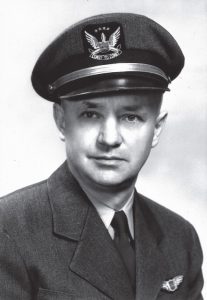
“My mother, Nadine, a surgical nurse from Iowa, was one of the first stewardesses for United Airlines,” Richard says. “She was on a flight to Chicago for her interview in January 1935 and my father was deadheading on the same flight.”
In those days, there would only be a few passengers on a flight, and keeping an eye on a pretty woman would have been easy.
“He kept track of her and made sure he was flying on her first day as a stewardess,” Richard says, adding that they were married a year later. “They stayed in love for the next 50-some years.”
From the time he was four years old, Richard knew what he wanted to do.
“My first memory was being in the car with my mother on the way to pick up my father, driving beside the airport about eight o’clock at night,” he says. “I remember seeing those blue taxiway lights. I was overwhelmed. I remember thinking, ‘I’m going to be part of this someday.’”
He grew up in Denver during the school year and on his grandparents’ farm during the summers.
“I had twin passions – aviation and ranching,” he recalls.
Eventually, Richard became one of commercial aviation’s youngest captains and went on to fly 747 jumbos. But that wasn’t his dream.
“I actually went back to the DC-9 so I could make five, six landings a day and do all the puddle jumping,” he says. “That’s what I loved best.”
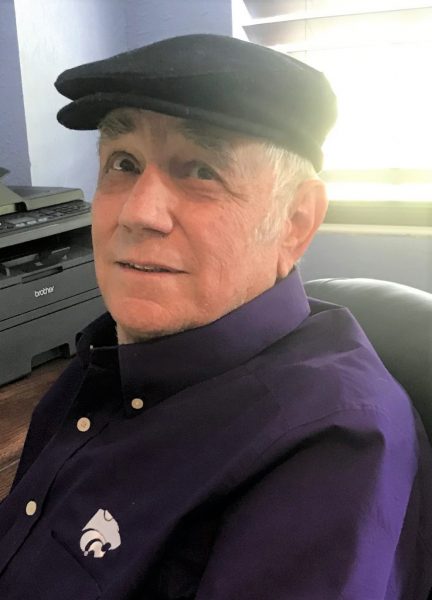
He lived in Phoenix, and in addition to flying, farmed cotton and alfalfa, ran a construction company and managed land syndication and development. Then, dissatisfied with life in the U.S., he moved the family to Australia.
“I was going to stay there the rest of my life, even became a citizen,” he says.
But the U.S. still had an attraction.
“We knew that at least some of our kids would want to go to U.S. universities and we didn’t want to do the long trips back and forth,” he says.
Twenty-seven years ago, he found a 265-acre ranch in Howey-in-the-Hills and settled in to raise Angus cattle.
“We had a cattle sale here in 2005 where we averaged $11,000 a head, which was a Florida record,” he says.
Recently, he sold off most of the cattle and the ranch is home to various critters including sandhill cranes, donkeys, horses, alligators, hawks and other birds. He writes thrillers featuring Jack Bear, a tough international agent who also is a part-time philosopher. He admires Lee Childs and his Jack Reacher character.
“I like Lee Childs’ books because they’re not full of filler – and because Jack Reacher never loses,” he says.
John W Prince is a writer and Villager. For more information visit www.GoMyStory.com. If you know of someone with a good story, contact John at [email protected].