
Donn Dears is very concerned about the current climate change news.
“My greatest concern is that climate change hysteria could cause us to make some very bad decisions about energy usage and energy development,” he says.

Unlike many who view greenhouse gases as detrimental to the planet, Dears does not agree.
“I’ve studied this issue for 20 years and after looking at the science, it’s my view that it’s not an existential threat,” he says.
In his several nonfiction and fiction books, Dears invokes the work of best-selling author Michael Crichton, who in a speech to the Commonwealth Club in 2003 compared environmentalism to religion. Crichton, who died in 2008, asked, “How will we manage to get environmentalism out of the clutches of religion, and back to a scientific discipline?”
Dears doesn’t dispute that planet Earth is warming, but that agreement comes with a caveat.
“Over the last 100 years, it has warmed by a degree or degree and a half,” he says. “The issue is not so much that it’s warming. It’s what’s causing the warming.”
Dears does not agree that carbon dioxide and methane – the most prevalent of the greenhouse gases – are a major threat.
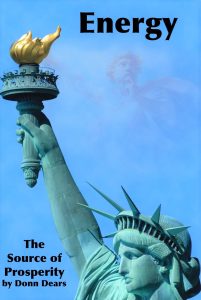
“If you look back over the past 10,000 years – since the last Ice Age – there have been more warmer periods, then cooling has happened. You can go back 1,000 years and it was warmer than it is today. Go back 2,000 years to the Roman warm period when it was warmer than now.”
Dears’ argument is two-fold: It’s not warming nearly as fast as many past predictions have warned, and we do not have the knowledge or technology to replace fossil fuels with alternate energy sources.
He adds that he is certainly not against the continuing research into alternate fuels and energy.
“Whatever is going to happen will happen because of the economics of the situation,” he says.
Electric trucks and vehicles are an example of economics driving circumstances, Dears says. Natural gas is about 63 percent efficient when it comes to generating electricity; the internal combustion engine has about 30 percent efficiency.
“But,” he continues, “about 80 percent of the energy we use comes from fossil fuels and there’s no way to immediately and economically replace them.”
Dears estimates that it would cost about $19 trillion – roughly the amount of our current national debt – to eliminate fossil fuels today. Much of that cost would be for be for energy storage equipment (batteries), which would have to be replaced every decade at a cost of another $19 trillion.
“We should use nuclear fuel even more,” he recommends.
Dears also is excited by the prospect of fusion as an energy source, but so far it takes more energy to cause the reaction than is produced. Dears cites a project in Europe that has a 10-year timeline to get a fusion reactor working.
“There’s a group in Washington state working on it,” he says. “The research should go on. It’s great.”
Dears grew up in Manhattan during World War II when many items were rationed and adults were frugal, remembering the recent Great Depression. “I was a lousy student at the time,” he recalls. “But I made a habit of going to the planetarium and the Museum of Natural History.”
He loved the sea and went to the U.S Merchant Marine Academy as an engineering student. The curriculum alternated a year of classroom followed by a year at sea on a merchant ship.
“I had seen the world by the time I was 19,” he recalls.
After graduating, Dears got an engineering job at General Electric, which was interrupted by active duty with the U.S. Navy during the Korean War. By this time, he had married Marian, his wife of more than 53 years, who died in 2007. A Julliard-trained concert pianist, she was attending an all-girls college near his Marine Academy. The two schools often paired off for dances and Donn’s designated date was Florence Henderson (who later went on to fame and fortune as the mother in “The Brady Bunch.”) But he liked Marian better and Florence had to find another date.
Returning to the U.S. from Korea, Dears kept moving up from one GE job to a better one, receiving training in many different aspects of the business on the way and eventually spending a number of years setting up joint ventures in the Middle East and other areas.
In 1998, the Young Americas Foundation purchased President Ronald Reagan’s ranch, Rancho del Cielo, in Santa Barbara, Calif. After retiring to the Chicago area in in 2007, Dears received a direct-mail piece about the ranch and the foundation.
“It really caught my attention,” Dears recalls, adding that he went on a cruise with the foundation and then visited the ranch. “They brought in high school and college students and taught them about Reagan, his beliefs and conservative thought,” Dears says.
He became a donor, has visited the Ranch several times and cruises annually with the group.
While the stereotype of engineers may be of people who are not writers, Dears writes every day, contributing articles every week to his blog, www.powerforusa.com.
“Most of my articles are on some aspect of energy,” he says.
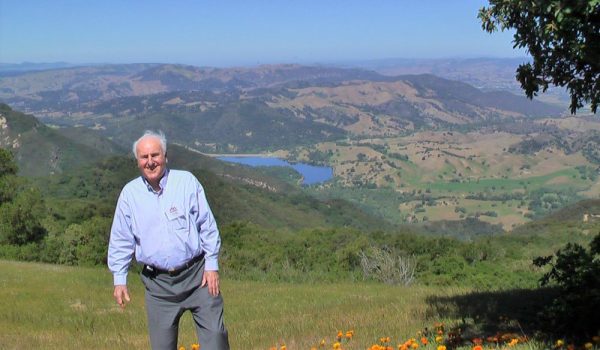
Dears writes from the study in his home in the Village of Collier where he has lived since 2015. His most recent article is on the Carrington Event that took place in 1859 when a powerful coronal mass ejection – solar flare – induced the largest geomagnetic storm on record. A similar event today could cause communications havoc, damage satellites and disrupt the power grid.
Dears says he has another book in “the embryonic stage” that involves energy auctions and the insider world of energy management and distribution.
“It’s a bit controversial,” he notes. “Yeah, of course,” he adds with a straight face.
John W Prince is a writer and Villager. For more information visit www.GoMyStory.com. If you know of someone with a good story, contact John at [email protected].