
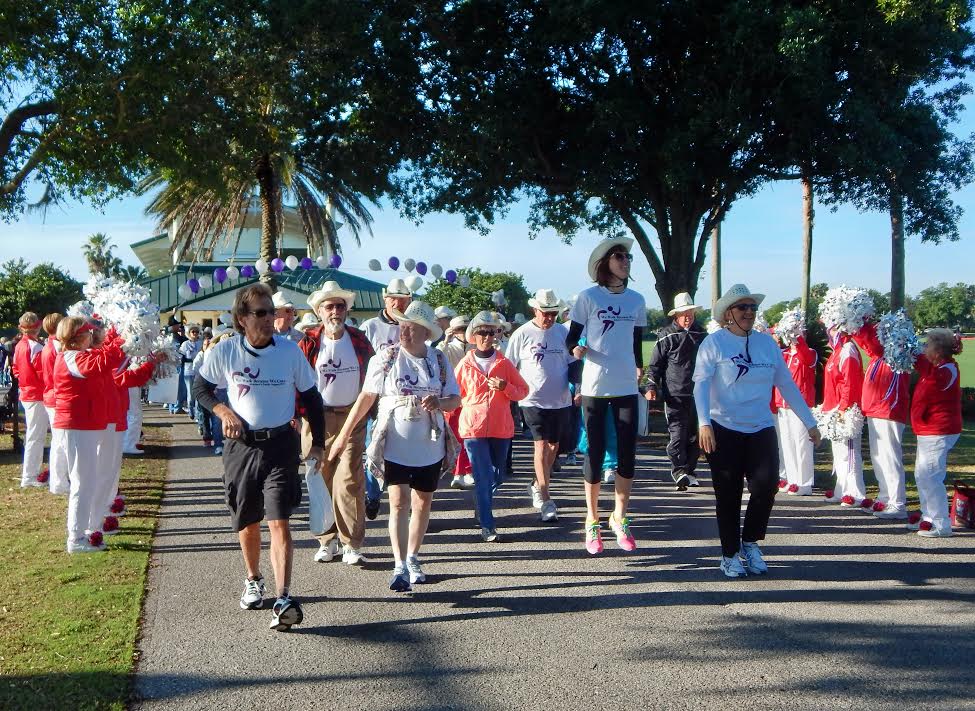
The 3rd Annual Alzheimer’s Family Support Walk kicked off Saturday morning at The Villages Polo Fields with cool breezes and temperatures in the upper 40s. Participants were largely Alzheimer’s patient caregivers, plus friends and relatives, who chose either a quarter-mile route or a more vigorous mile and one-half trek.
Songs by Ralph diNome and the Last Tyme Out Bluegrass Band kept a lively beat as walkers strutted to strains of ‘I Did It My Way.’ About 250 walkers from Freedom Pointe were out enjoying themselves, in white straw cowboy hats; and a team from Sumter Place Assisted Living wore little flags in their black western hats. A New Covenant United Methodist Church banner led another huge team of Alzheimer’s supporters.
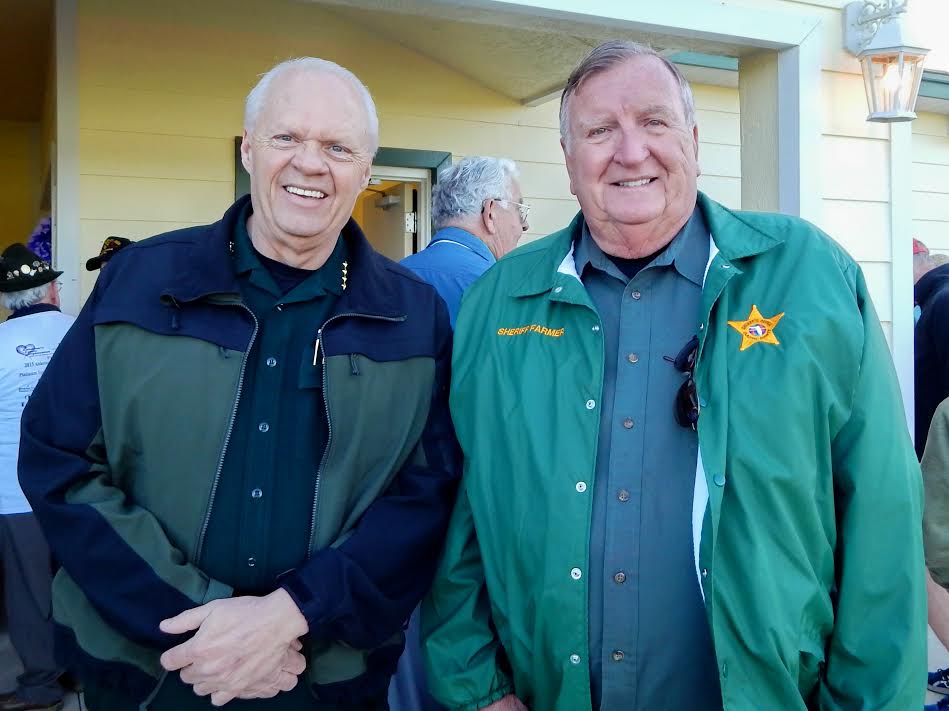
The U.S. flag, plus the colors of the five military service branches, were presented by the Col. Philip C. DeLong Marine Corps. honor guard, and both Sheriff Gary Borders from Lake County and Sheriff Bill Farmer from Sumter County were on hand with several senior officers and deputies. While the Lake and Sumter County Sheriff’s Offices work closely together in their law enforcement and rescue operations, the two sheriff’s enjoyed the rare face time they shared Saturday morning at the event. “This doesn’t happen too often,” Sheriff Farmer said. “This is good,” Sheriff Borders echoed.

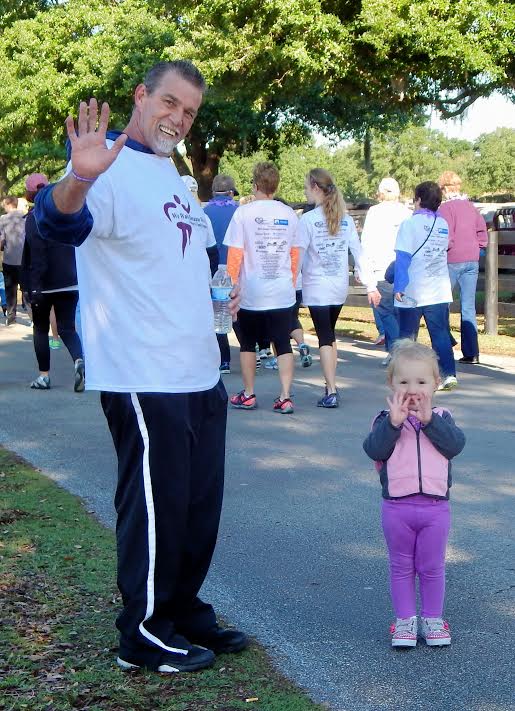
Sisters Janet Sanborn and Brenda Jackson met up with their friend Phyllis Wann, all wearing lilac flower leis — marching for a Gilchrist Vilage neighbor’s sister-in-law, who has Alzheimer’s disease. Perhaps the youngest walker was a sweet little girl named, Justyce, who’s almost three — accompanied by her grandpa, Tal Elmore, who is director of nursing services at Sumter Place.
Alzheimer’s disease is the most common form of dementia, or loss of intellectual functioning, among people age 65 and over. It is a progressive, degenerative disorder which attacks nerve cells in the brain, resulting in memory loss, impaired language skills, decreased cognitive functioning and behavioral changes.

People of all ages forget where they put their keys or glasses, but Alzheimer’s patients may forget their son’s or grandson’s name; how to turn on the television or cook an egg. Alzheimer’s patients’ cognitive impairment differs, depending on which section of the brain is under attack — for example, short term memory problems stem from the brain’s hippocampus; whereas the ability to form words and coherent sentences and judgment are centered in the cerebral cortex.
Best estimates put the incidence of ‘probable Alzheimer’s Disease’ among Americans at about 5.1 million persons — the term ‘probable’ being used because Alzheimer’s can only be definitively diagnosed on autopsy. Patient diagnoses are made based on clinical signs and symptoms. While Alzheimer’s is definitely not a normal part of growing older, the risk of developing the disease rises after one reaches age 65 — doubling every five years after that age. In addition, about one-half million Americans under 65 have some form of dementia, including early onset Alzheimer’s, according to the Alzheimer’s Foundation of America.
Alzheimer’s patients live on average 8-10 years after diagnosis, and tend to develop co-existing illnesses, most commonly fatal pneumonias. The illness is among the top ten causes of mortality in the United States. A variety of tablets, capsules, liquid medications and patches are prescribed in an attempt to slow Alzheimer’s progression and improve sufferers’ quality of life.
The monetary cost of the disease to society is enormous. Families pay on average $18-36,000 each year to manage the disease, depending on the stage and severity of each case. The cost of treating Alzheimer’s disease in the U.S. may meet or exceed an estimated $100 billion annually, with costs to businesses estimated at $60 billion every year in lost productivity and absenteeism among caregivers. In most situations, one to four family members are involved in the daily care of these patients — and the cost to them in terms of life disruptions and stress is incalculable.

The Alzheimer’s Foundation of America funds research to find a cure; and seeks to educate patients and caregivers on how best to cope with this epidemic among our senior population. Caregivers are guided to encourage and praise persons with Alzheimer’s disease, to agree instead of argue; to distract or divert the patient’s attention from problem situations and reassure them everything is OK.
Proceeds from Saturday’s walk in The Villages will benefit the Alzheimer’s Family Organization (727 848-8888). The Alzheimer’s Caregiver Support Group in The Villages meets at 6:30 p.m. the third Wednesday of each month at Mulberry Grove Regional Recreation Center on Mulberry Lane, off Route 42, at the Northern perimeter of The Villages. The Rec Center number is 352 259-6040. For support group information, phone 751-1808 or 446-4203.
To reach the Alzheimer’s Foundation of America Hotline, phone toll-free: 866 232-8484.