

The sweet sounds of Shirley Alston Reeves brought back memories of the Shirelles.
The hard-driving beat of the Crystals’ “Da Doo Ron Ron” tossed another brick on Phil Spector’s “Wall of Sound.”
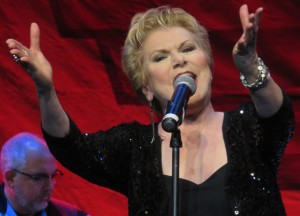
And a petite woman from just outside of Philly made you think of a little girl with a big voice named Peggy March.
They – along with the sassy, sexy and glittery local trio known as FOXXX – had a big Savannah Center crowd rocking in sisterhood Wednesday night.
It was all part of “Rocky’s Lady Legends of Rock and Roll,” featuring Gerry “Rocky” Seader and his band, The Rollers.
Put “dose” guys and “dese” gals together – as Rocky might say – and they can’t help but party down with music.
Shirley Alston Reeves made it to the Rock and Roll Hall of Fame in 1996 as lead singer of the pioneering female group, the Shirelles.
Long before the Supremes, Destiny’s Child the Spice Girls or Dixie Chicks, the Shirelles established a girl group sound that hit it big.
The most memorable number was “Will You Still Love Me Tomorrow,” written in 1960 by Carole King and Gerry Goffin. It’s a standard as a bittersweet love song, but also a philosophical statement for women who came of age in the late ‘50s and 1960s.
You can see a clip of Reeves and others in Wednesday’s show here:
Alston Reeves, 74, still resonates with charm and a stirring, gentle voice. Her vocal gave “Will You Still Love Me Tomorrow” a kind of soft, emotional blanket that made you feel warm inside.
But the Shirelles were far from one-hit wonders.
“I wrote this song back in the good old days when McDonald’s only had one golden arch,” she said introducing the number, “Tonight’s the Night.” It had that steady beat and sheer vocal that Alston Reeves mastered throughout her long career.
There was more light pop on “Foolish Little Girl” and “Mama Said.” Things got soulful and a little funky on “Baby It’s You,” a song covered by the Beatles and also a big hit for A Group Called Smith in the late ‘60s.
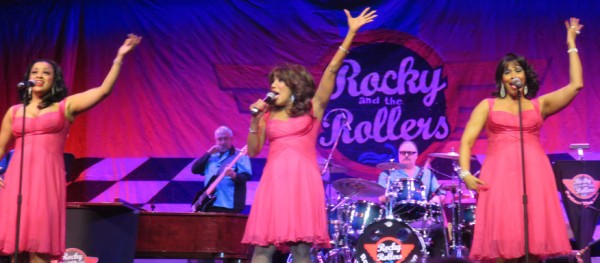
Alston Reeves and her two backup singers ended the set with the Shirelles military tribute, “Soldier Boy,” and they earned a long and loud standing ovation.
The Crystals were part of Phil Spector’s girl group powerhouse in the 1960s that helped define the producer’s “Wall of Sound.”
Female singers were like interchangeable parts for Spector, and the roster included Darlene Love, the Ronettes, the Blossoms and the Crystals.
The Crystals started singing for Spector while they were still high school students. “We were five girls from Brooklyn and we would do anything to sing,” said Dolores “Dee Dee” Kenniebrew, the lone original Crystal on stage. She was joined in the trio with Patricia Pritchett-Lewis and a singer known as MelSoulTree.
They percolated with energy all night long and were in a dancing groove on one of Spector’s classic numbers, “Da Doo Ron Ron.” The vocal pace was equally frenetic on the former No. 1 single, “He’s A Rebel.”
The Crystals tossed in a couple of other rockers, “Then He Kissed Me,” “Uptown” and “He’s The Boy I Love.”
Peggy March was just a kid in Catholic High School back in Lansdale Pa. Then, in 1963, she cut a record called “I Will Follow Him,” and the 15-year old was singing on “American Bandstand” and topped the record charts.
“My mother said I couldn’t dance on Bandstand because I was too young,” she said from the stage. “So I would up singing on Bandstand.”
March was in vintage form on her big number and also offered a riveting version of “Bridge Over Troubled Water” that earned a standing ovation.
FOXXX features Villages favorites Kathleen Kane, Jules Larsen and Petrina Amsden. They continue to raise temperatures every time they hit the stage.
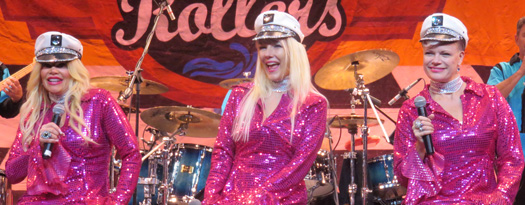
The group opened up with a couple of real oldies, “Boogie Woogie Bugle Boy” and “Be My Baby.” But things really exploded when singer Al Morse showed up to join the Foxy ladies in a robust, rollicking cover of Ike and Tina Turner’s “Proud Mary.”
Morse slowly strolled on stage, singing Ike Turner’s bass part and then the ladies took over and nearly blew the roof off.
 “Rock and roll was dominated by men,” DJ Al Brady, MC for the concert, said. “Tonight you’re going to meet some women who changed music and made it better.”
Villagers Ellen and Jim Bauer agreed.
“I can’t tell you the names of the groups or the titles of the songs, but as soon as I hear them, I remember them,” Ellen Bauer said. “We all grew up with this music and it’s part of our lives. I like the music today, but it’s not the same.”
The attachment to the old songs remains strong.
“It takes you back to your youth,” Jim Bauer said. “A show like this is great, because it brings all the groups together on one stage. I give Rocky and these ladies a lot of credit. They still sound great.”