
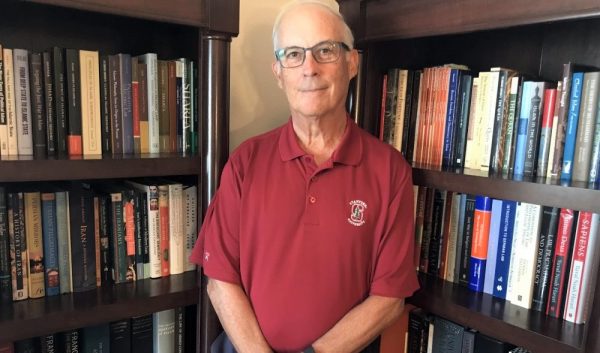
The least litigious country in the world is probably Japan, according to Dr. Mark Welton, who has made a career studying, among other legal topics, comparative and international law.
“It’s because of the culture,” he says. “You deal with disputes out of the public eye. It’s harmony and settling disputes among family.”
He also says that there are virtually no crime or law dramas on Japanese television.
“Comparative law takes the basic idea of law, and how law operates, and compares it among the three major legal systems in the world,” he explains.
The three systems are the common law of the United States, the United Kingdom, Canada, Australia and other Commonwealth countries; the Roman law tradition which is prevalent in civil law throughout Europe; and the religious legal systems, of which the Islamic countries make up the largest group.
He also practiced international law for many years. That is the study of law among countries and jurisdictions with regard to activities between countries such as trade, banking and financial matters, and the conduct of warfare.
“One percent of the work deals with war and 98 percent is about nations cooperating in terms of trade and so forth,” he says.
The latter was a mainstay during Mark’s 23 years with the U.S. Army in the office of the Judge Advocate General’s office while stationed in the U.S. and overseas. Having an international outlook came naturally to Mark. Growing up in Northern California, his businessman father often entertained colleagues from all over the world.
“I loved the food and the culture,” he says. “And that got me interested in international work.”
After graduating from Stanford with a major in German studies, Mark entered Georgetown Law School because it had a very good international law program. Then he worked for year for a D.C. law firm, still with the objective of going international.
“I found out that the U.S. Army offered an opportunity through the JAG Corps to do international work, as well as live and work abroad,” he says.
His plan was to stay a few years and then do something else.
“Well, I stayed for 23 years because they kept giving me jobs I really enjoyed,” he says.
Being fluent in German gave Mark a leg up in Europe. He was stationed in Heidelberg and was chief of international law for the Army in Europe and a legal officer at the American embassy.
“My kids basically grew up in American schools in Germany,” he says.
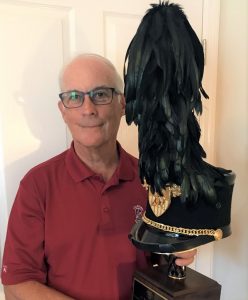
One of Mark’s other great passions is education, and he worked at West Point Military Academy from 1979 to 1982 teaching constitutional and military law.
“The law studies program at West Point is designed like other social sciences to teach about how societies work,” he says. “As soldiers deploy all over the world, they are subject to a lot of international law, status of forces agreements and the law of armed conflict. All of these things affect your professional and personal life abroad.”
Mark got an opportunity to return to West Point after his retirement from the Army in 1999 as a civilian instructor, where he directed the international comparative legal studies program.
Throughout his legal career, Mark has focused on Islamic law.
“One of the big misconceptions is that Islamic law – Shira law – is the same all over. It’s not,” he says. “There are Sunni and Shiite schools of Sharia law.”
Mark also says that some countries, such as Iran and Saudi Arabia, practice a stricter form of Sharia law than countries like Malaysia or Turkey. He notes that even though Sharia law has punishments such as hand amputation for thieves, it was seldom implemented, even back in the Middle Ages.
“It was seen by most Muslim judges as something to be avoided except for extreme cases,” he says.
John W Prince is a writer and Villager. For more information visit www.GoMyStory.com. If you know of someone in or around The Villages with a great story, please contact [email protected].