
Love it or loathe it, Florida-Friendly Landscaping celebrates its 28th birthday this month.
Based on a core of nine principles, Florida-Friendly Landscaping promotes low-impact, sustainable, environmentally friendly landscapes that conserve water, reduce pollutant loading to Florida waters and protect Florida’s natural resources.
Kicking off in February 1993 with a $75,000 grant from the Florida Department of Environmental Protection, that agency partnered with the University of Florida Institute of Food and Agricultural Sciences to form Florida-Friendly Landscaping. Since its modest start, Florida-Friendly Landscaping has grown into a comprehensive statewide program that is active in 51 of Florida’s 67 counties.
Florida-Friendly Landscaping doesn’t always receive a warm welcome in Florida’s Friendliest Hometown.

A home owned by New Jersey snowbirds at 2111 Sansores St. in the Village of Santo Domingo has recently fallen under scrutiny for its Florida-Friendly Landscaping. Next-door neighbors attempting to sell their home recently complained to the Community Development District 2 Board of Supervisors. The New Jersey couple has replanted a different variety of Florida-Friendly Landscaping and are on a tight timeline for it to come in successfully. If it doesn’t, the couple could face fines.

Last year, a Village of Piedmont woman sought forgiveness for $400 in fines she racked up over her Florida-Friendly Landscaping. Her neighbors had complained it look like “a jungle.”
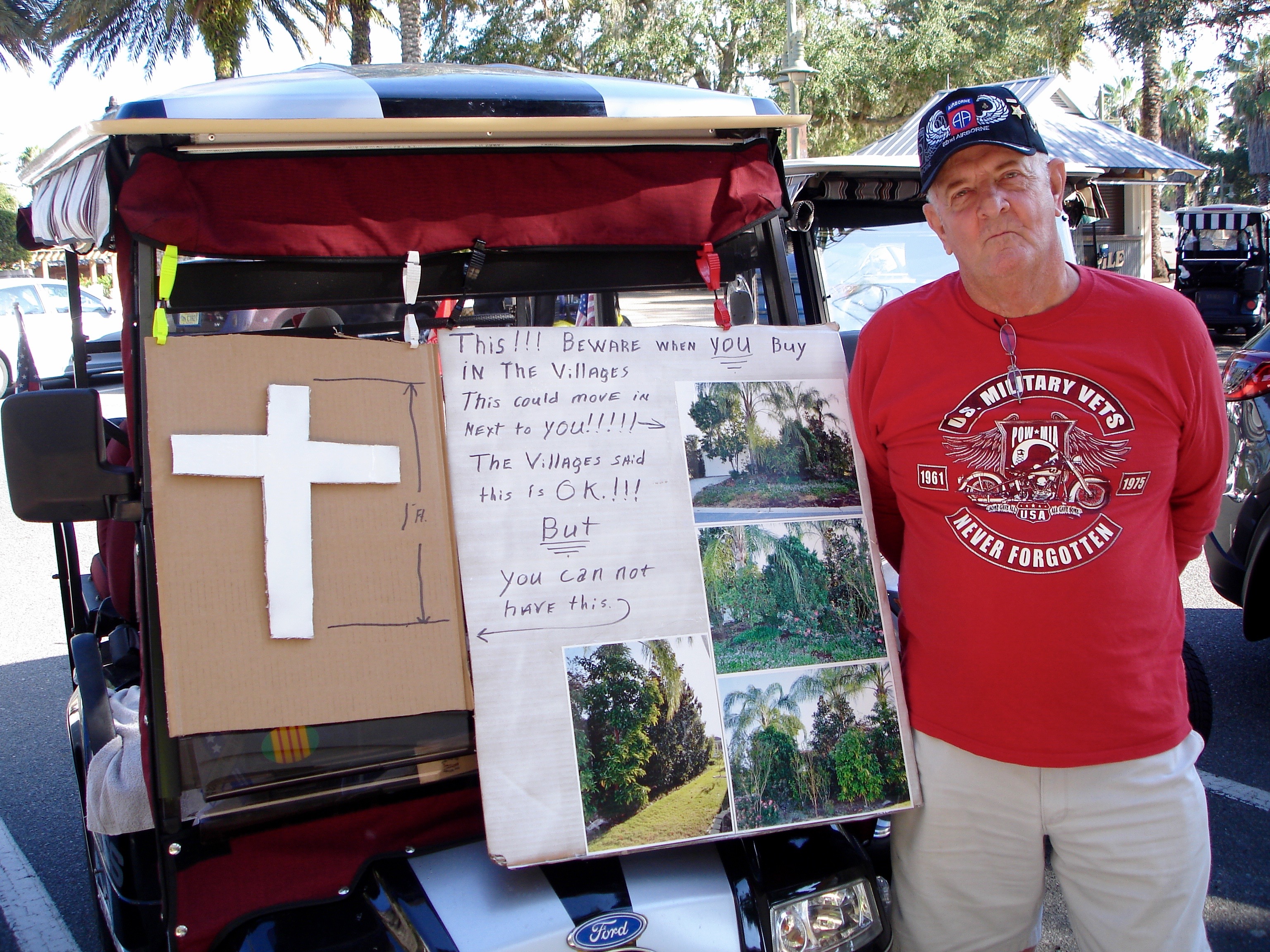
Craig Bonifant of the Village of Amelia had the same complaint about a home in his neighborhood. He took his protest to Lake Sumter Landing.
Despite the fact that some residents are vehemently opposed to Florida-Friendly Landscaping, take a drive south of State Road 44 and it is apparent the Developer has embraced drought-tolerant plants. The plants need less irrigation than non-native plants.